

Safe personnel with verified background
Background checks in accordance with the CER Directive and Swedish law - ordered and conducted directly via the Right to Work portal.
Safe personnel with verified background
As an add-on to a Right to Work check, we offer background checks in accordance with the CER Directive and within the scope of what Swedish law permits. The checks are ordered and conducted directly via the Right to Work portal.
Criminal record extract - when and how we review it
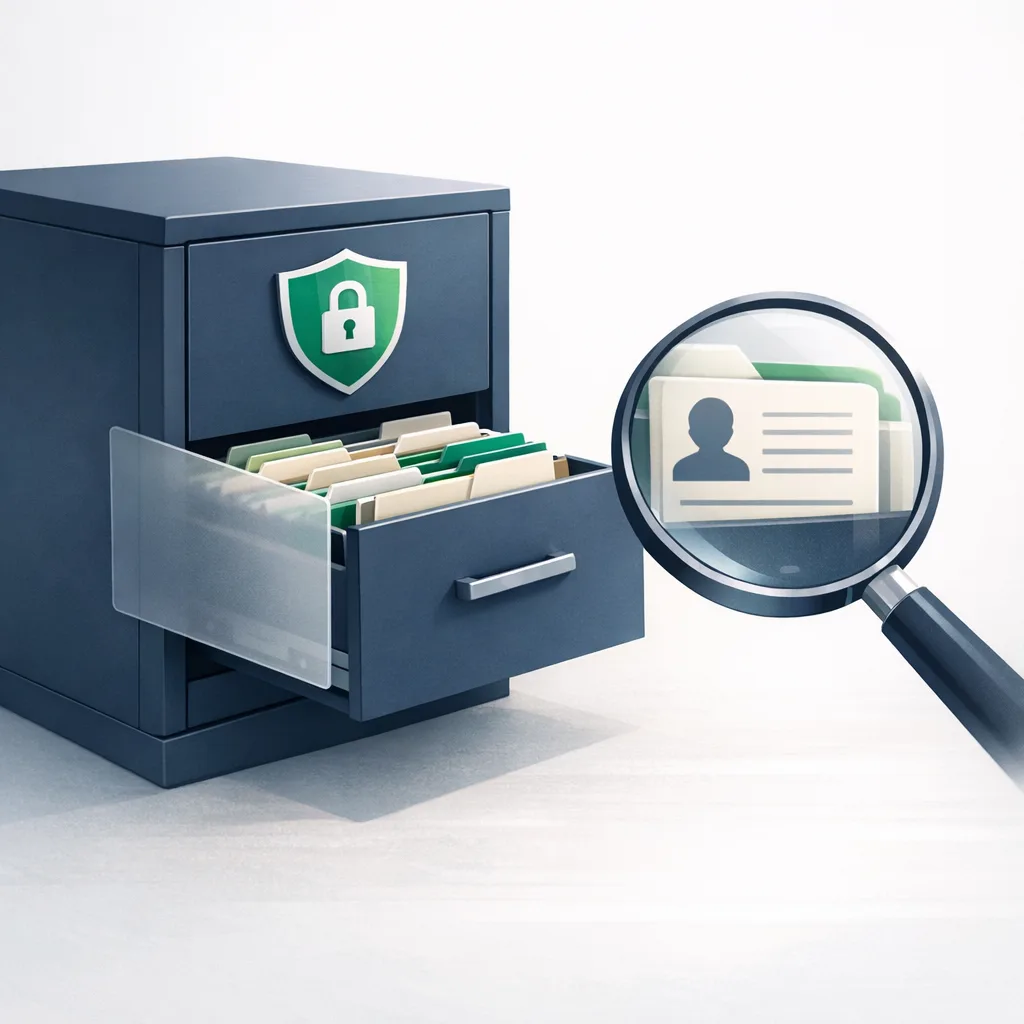
When Swedish law or industry regulations require a criminal record check, Sistec can, as part of our individual checks, review a candidate's or employee's criminal record extract brought to the appointment.
The person orders their own extract from the Police Authority and presents it at the check appointment. We never handle or store the extract itself, but only make a note that it has been presented and reviewed in accordance with applicable law - the same principle proposed in government inquiries on background checks.
What the extract looks like – security paper and protective features
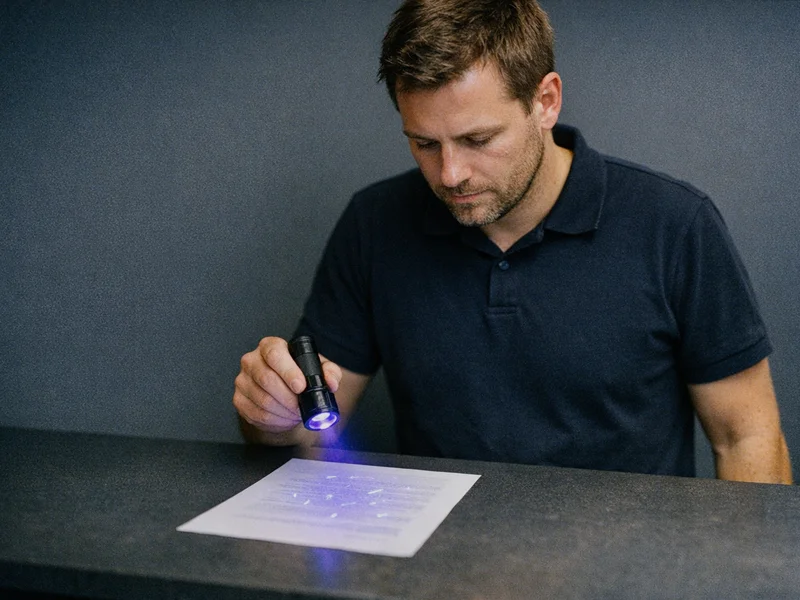
The criminal record extract is printed on specially ordered security paper. The paper is wood-free and uncoated, typically 90–120 g/m², designed for laser and inkjet printing. It contains UV fibers (fluorescent security fibers) randomly embedded in the paper pulp, visible only under UV light.
The visible pattern on the paper is called a guilloché pattern – a geometric, repetitive security background printed directly on the paper. The combination of printed guilloché and UV fibers provides medium to high document security. This design is organization-specific and not available as a standard product – it requires a special order through a security printer.

Visual inspection of the guilloché pattern
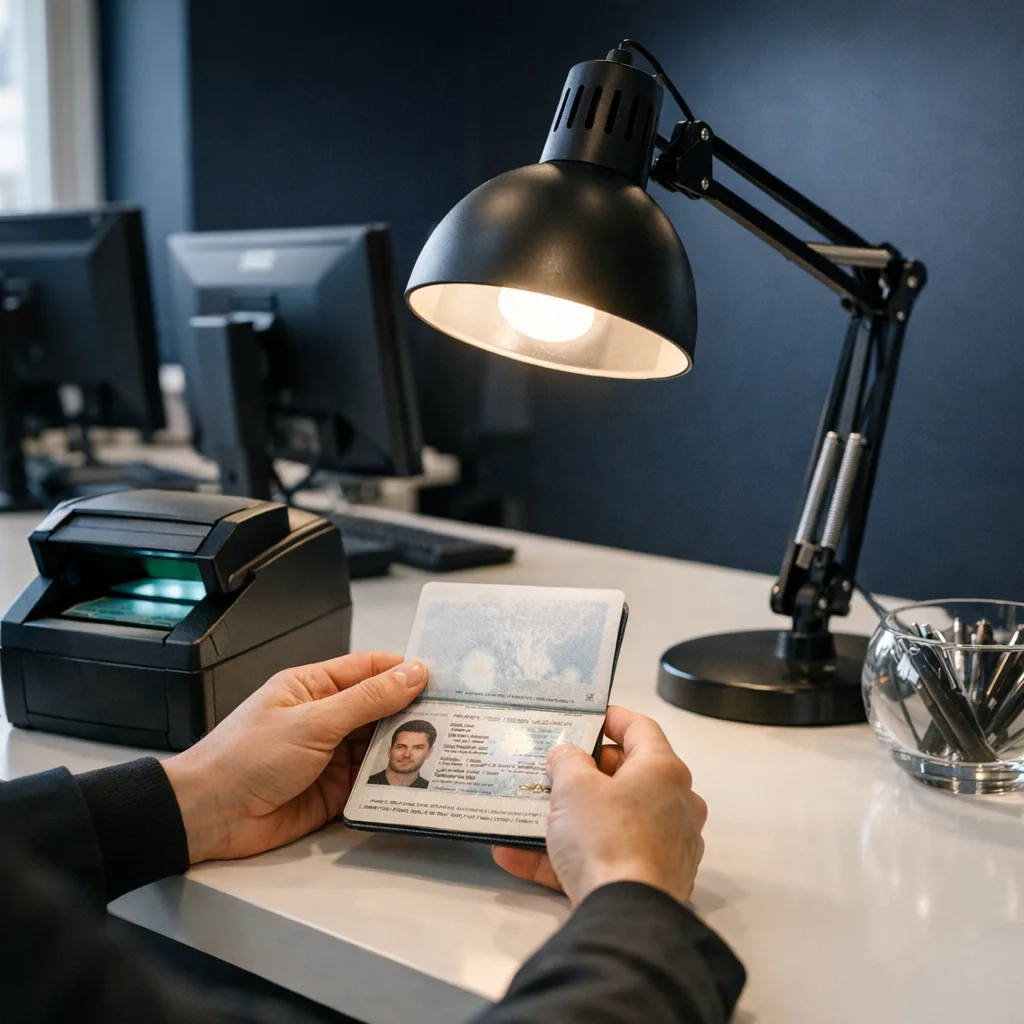
The pattern check is carried out in normal white light and with angled illumination. The document is placed on a flat surface and illuminated from the side at a low angle to clearly reveal the guilloché pattern and its continuity.
The pattern is visually compared against a known reference specimen, focusing on geometric precision, line density, and repetitive structure. When needed, transmitted light is used to confirm that the pattern is a printed security background and does not show anomalies that could indicate copying or reprinting.

UV fiber inspection
The UV check takes place in a dimly lit room using a handheld UV lamp (365 nm). The document is illuminated evenly to verify that fluorescent fibers appear randomly distributed throughout the paper pulp.
The fiber colors – for example white, blue, or red – are identified and compared against known specifications. The focus is on confirming that the fibers are embedded in the paper rather than printed on the surface, and that color, length, and distribution match the expected profile.

Sistec's assessment during the physical meeting
During the physical meeting, Sistec carries out all checks to verify the authenticity of the extract. The inspection result is assessed as a whole during the meeting. Deviations in pattern, poor line quality, or incorrect UV colors are documented immediately and may indicate that the document was not produced on the correct security paper. The combination of visual pattern verification and UV inspection provides a reliable and practical level of control well suited for identity and document checks in a physical setting.
Once the authenticity of the extract has been verified, the information on the extract is also checked through the police verification service.
How Sistec conducts the review
Physical meeting
A personal meeting with the individual where the review is conducted.
Criminal record
Review of the person's criminal record extract brought to the appointment.
ID authenticity analysis
Authenticity analysis of the individual's ID document.
Identity & citizenship
Confirmed identity and citizenship.
Work permit
Authenticity analysis of work and residence permits and verification with the Swedish Migration Agency.
Driving license
Authenticity analysis of driving license and verification with the Swedish Transport Agency.
Criminal record reminders
Automatic reminders for new criminal record checks for existing personnel (CER).
Right to work reminders
Reminders for new right to work checks for existing personnel from third countries.
All processing is carried out in accordance with GDPR, and we never store sensitive data from the register extract itself - only the note that it has been presented.
Background checks in municipal operations
In municipal operations, there is a clear shift where background checks are expected to become more common, both during recruitment and for existing staff. Investigations particularly emphasize that a background check must always be preceded by a correctly established identity, since the register has no value if the identity is not established.
When is a criminal record extract required?
Municipalities may request that an individual present an extract when the person will work in areas where the legislator explicitly requires it, for example:
- School or preschool
- LSS services (children with disabilities)
- Youth activities and other activities for children (e.g. coaches, youth leaders)
- Residential care homes (HVB)
- Insurance distribution
- Personnel in essential services
In these cases, the check is an integral part of ensuring safety and protection.
Critical entities - the Resilience Act (LOM)
The CER Directive (Critical Entities Resilience) requires that critical operators must conduct background checks on personnel with access to security-critical environments. Both employees, consultants, and suppliers are covered. The directive enters into force through the Resilience Act (LOM) in 2026.
According to the Swedish inquiry, the checks shall include:
Verifikation av identitet
Granskning av medhavt utdrag ur belastningsregistret
Regelbunden uppföljning för befintlig personal - minst vartannat år
This means that both municipalities and other critical entities need workflows that handle recurring checks and secure documentation.